A Comprehensive Guide to
Every Step of the Journey for Academic Candidates.
Welcome to the Faculty Job Search Guide
The tenure-track faculty job search is one of the most challenging yet rewarding journeys in
academia. Having
recently gone through this process myself, I found that while every candidate’s path is unique, many
of the
underlying challenges—crafting a coherent application, presenting your research vision, and
navigating the
interview process—are shared across disciplines and institutions. This guide brings together the
strategies,
lessons, and reflections that helped me along the way.
It is built on practical experience—what worked, what didn’t, and what I wish I had known earlier.
Much of this
insight came from mentors, peers, and practice sessions that provided constructive feedback at every
stage. My
goal here is to distill that collective learning into a concise, structured roadmap that future
candidates can
adapt to their own journeys.
While this guide reflects my personal experience, it is not meant to replace the many excellent,
expert-driven
resources already available through professional networks and university career centers. Instead,
think of it as
a companion—something that offers a firsthand perspective from someone who has just been through the
process and
emerged on the other side.
This guide is based on an invited talk I delivered to my alma mater,
Rochester Institute of Technology (RIT), in Fall 2024—during the beginning of my faculty journey at UTEP.
The session was designed to help graduate students and early-career researchers prepare for the
tenure-track job search with practical strategies and real experiences.
Once I began preparing my application package, I quickly realized that this stage shapes almost
everything that
follows in the faculty search process. It is the foundation that determines whether you move forward to
interviews—and it requires far more than simply assembling standard documents. Each piece needs to work
together to
present a clear, consistent narrative about your academic identity and potential.
The key insight I gained was that fit and cohesion matter more than volume or polish.
Search
committees are not only scanning for achievements; they are trying to understand the person behind the
record—how
your research, teaching, and service philosophy align with their department’s mission and culture.
What helped me most was thinking of the application package as a complete professional
narrative rather
than a checklist. Your materials should move in harmony: the cover letter introduces your vision, the
research
statement expands it, the teaching and diversity statements humanize it, and the CV provides evidence
for it. When
these elements are consistent, your application feels intentional and memorable.
Cover Letter
+
What it is and
why it matters
The Cover Letter was the first piece I worked on, and it set the tone for everything else.
It is your
opportunity to translate your record into a story that resonates with a specific department.
What worked for me was approaching it as a guided conversation—speaking directly to
the
department, showing I understood their priorities, and explaining how my research and
teaching could
complement their existing strengths. Generic letters are easy to spot, so taking the time to
tailor each
version was well worth the effort.
Rule of Thumb: concise (1 page), department-specific, and written in your authentic voice.
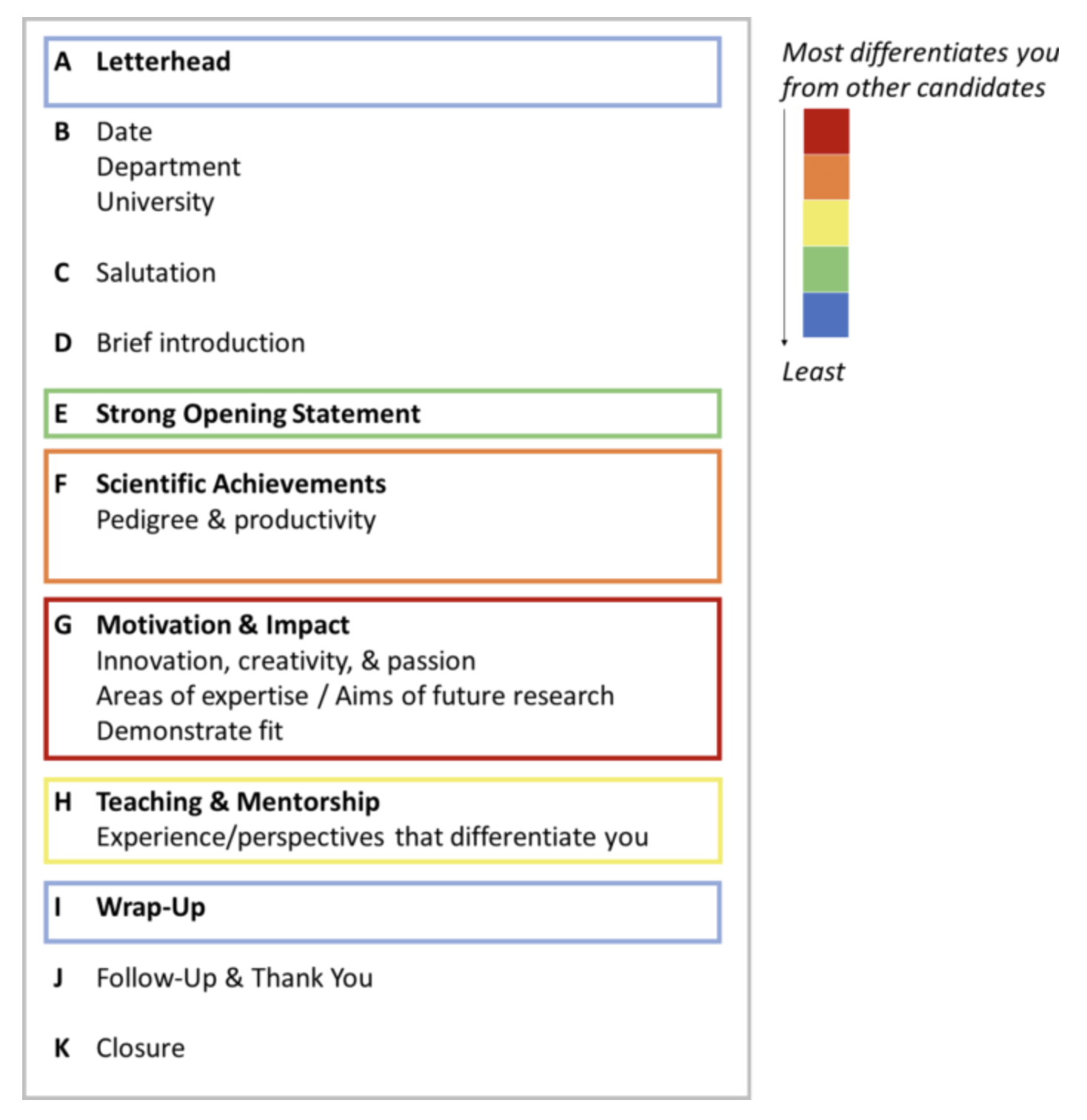
Structure That Worked for Me
Opening: Clearly state the position and your current status (Ph.D.
candidate,
postdoc, etc.). A direct start is appreciated by readers.
Overview of Research: Summarize your area and highlight one or two key
contributions that define your research identity. Keep it accessible across subfields.
Connection to Department: Mention specific faculty, research
directions, or
teaching needs that align with your work. Demonstrating awareness of their context shows
genuine
interest.
Future Vision: Briefly describe what your next steps would look
like—how you plan
to grow your research program or expand collaborations.
Teaching and Mentoring: Share a concise teaching perspective or a
meaningful
experience that reflects your values as an educator.
Closing: End with appreciation and enthusiasm, expressing openness to
further
discussion.
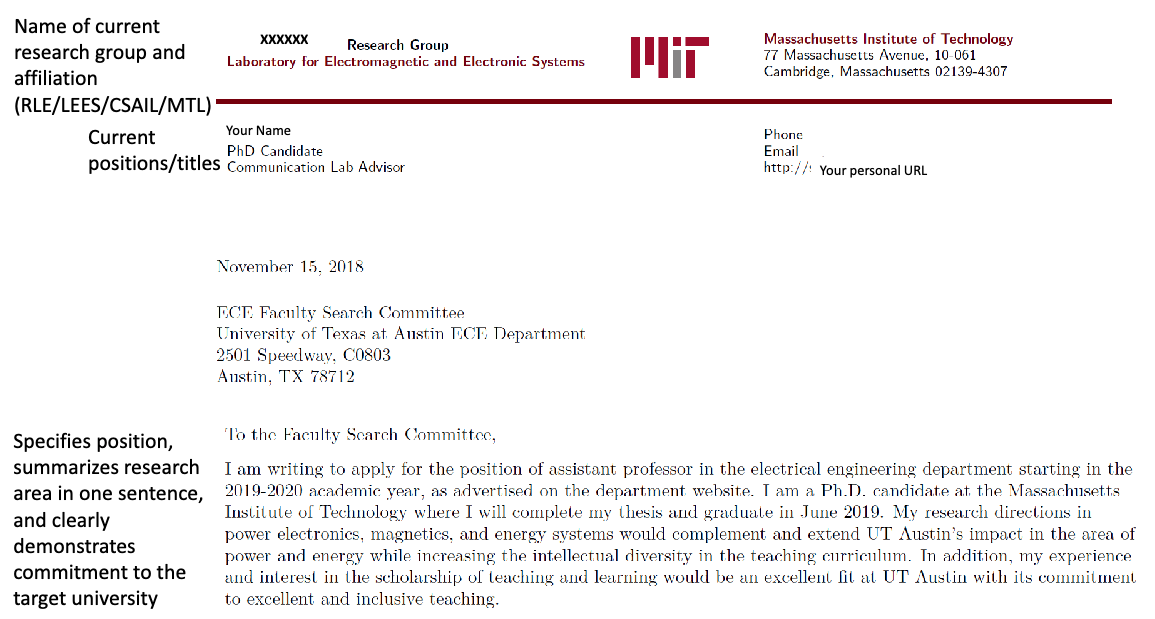
Figure: Annotated Sample Cover Letter (MIT EECS Example).
Figure: Cover Letter Format and Structure Overview.
Academic Resume / CV
+
What is it and
why is it significant?
The Academic Resume (or Curriculum Vitae, CV) is a comprehensive record of your professional
and academic life. Its significance lies in providing the evidence (publications,
awards, mentoring/advising history, service) that backs up the claims made in your statements,
allowing the committee to quickly assess your trajectory and productivity.
Essential CV Sections:
Name & Contact Information
Education
Research Interests and Experience
Publications
Teaching Experience
Student Advising
Awards & Grants
Services (PC/Reviewer roles)
Talks and Presentations
Anything else you deem the committee should know about you.
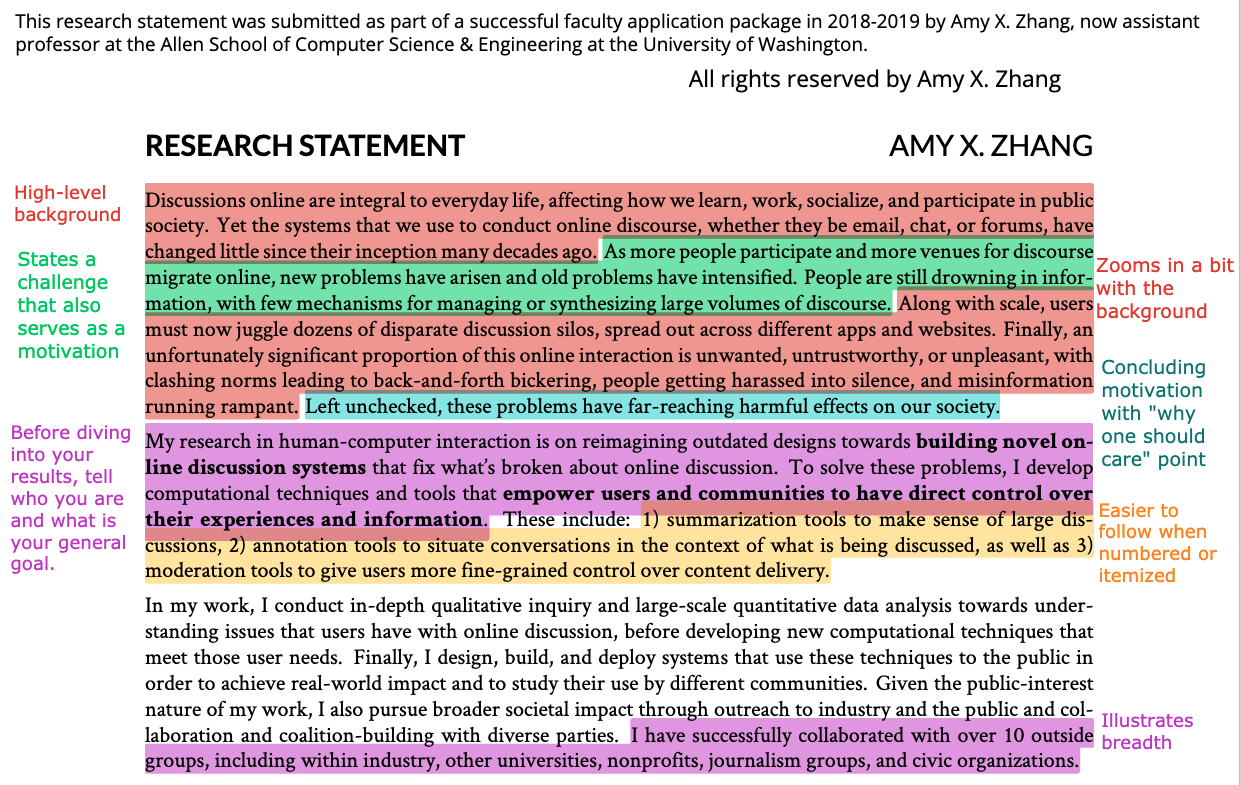
This statement is a narrative detailing your past accomplishments, current work, and, most
importantly, your visionary 5-10 year research agenda. Its significance is defining
your unique academic BRAND (i.e., who are you?), demonstrating the potential for long-term funding, and
establishing potential collaborative breadth within the department and institution.
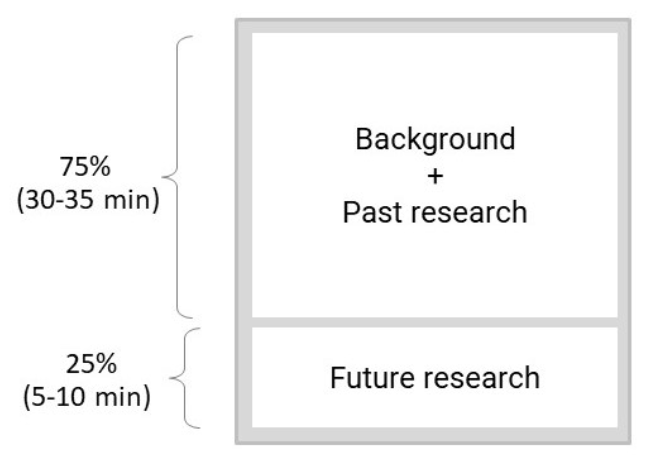
Rule of Thumb: Max 5 pages with references. Focus
55% on past work and 40% on future vision (my structure). Include figures/diagrams.
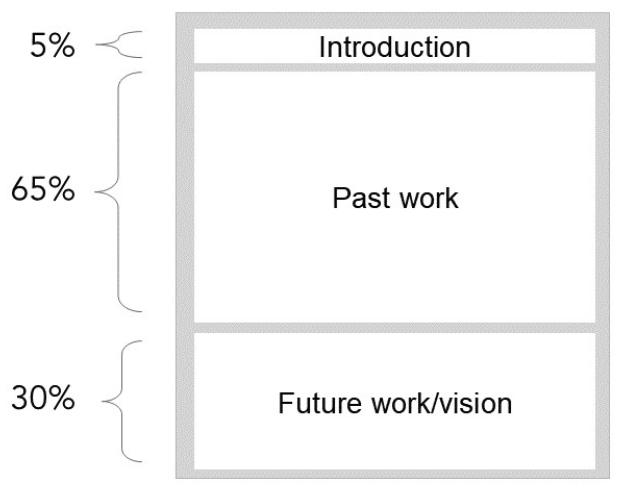
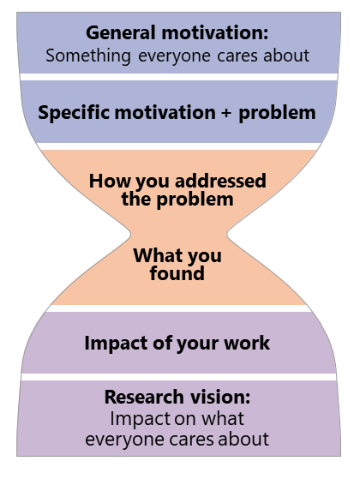
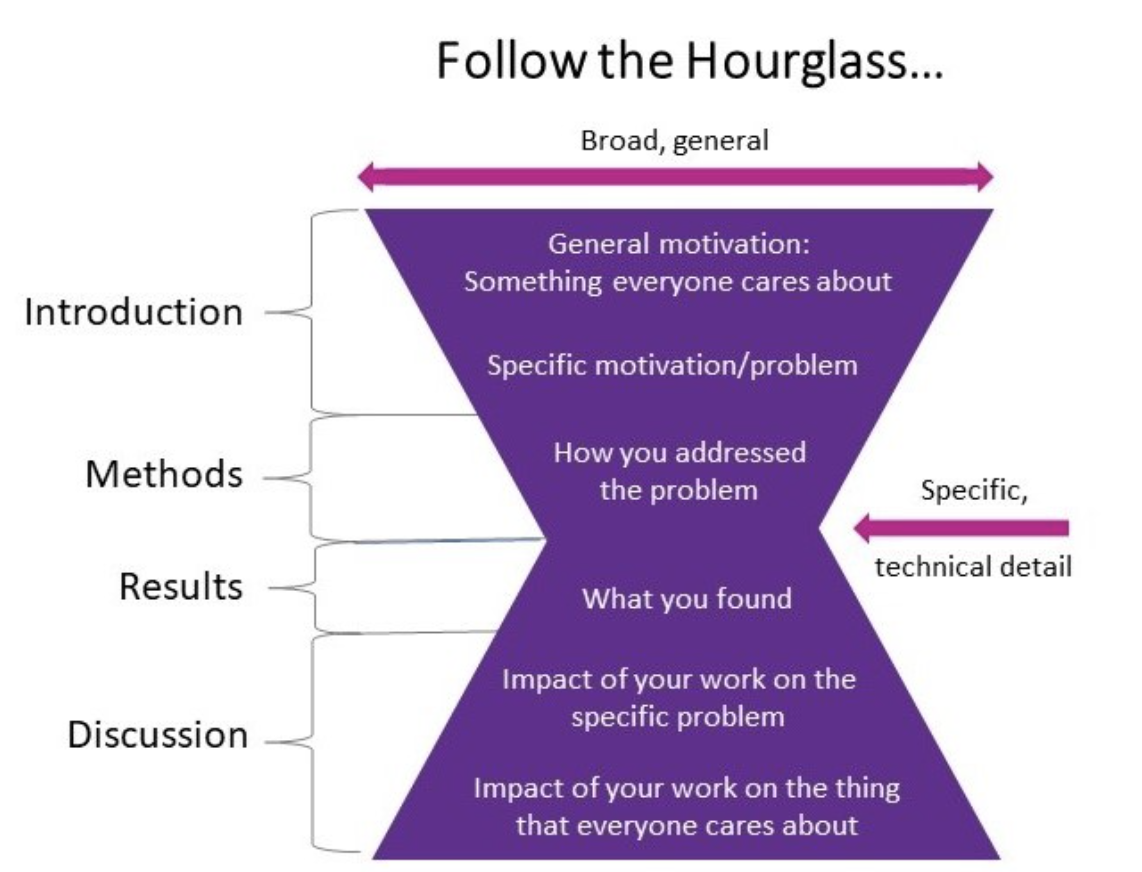
Key Elements & Structure (Hourglass
Model):
Introduction (5%): Broad motivation (why everyone cares), specific problem.
Past Work (65%): Detailed findings, methodology, and impact of your dissertation
work.
Future Work/Vision (30%): Articulate your Brand, interconnect future research
directions, and propose the broader impact of your ongoing work.
Focus on: Broader impact, why the problem is
important, and clear communication of your brand.
Figure: Example structure of a Research Statement format.
Figure: Example flow illustrating research vision and thematic alignment.
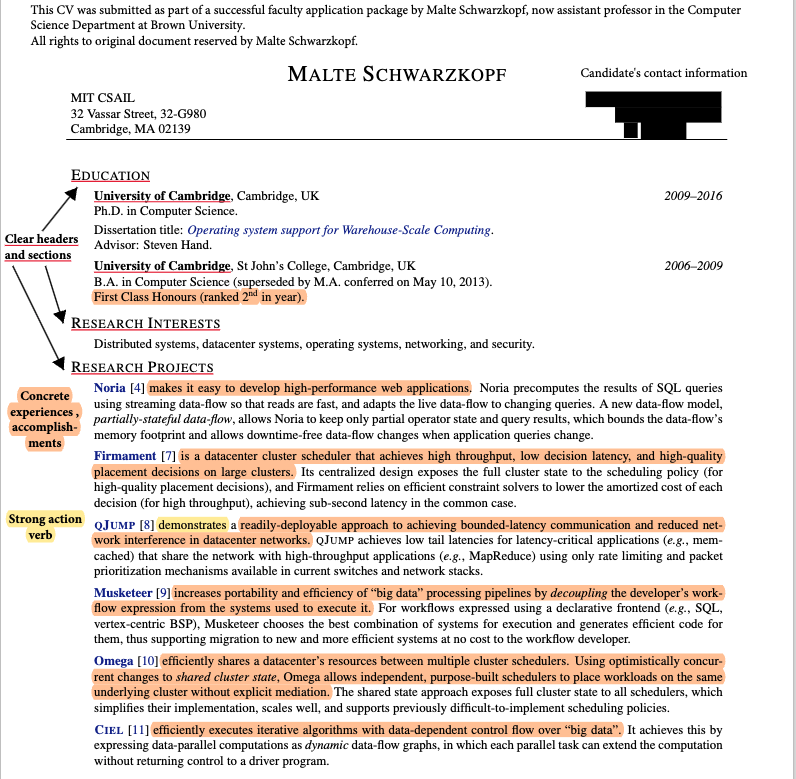
Figure: Sample excerpt illustrating research narrative and structure (Example 1).
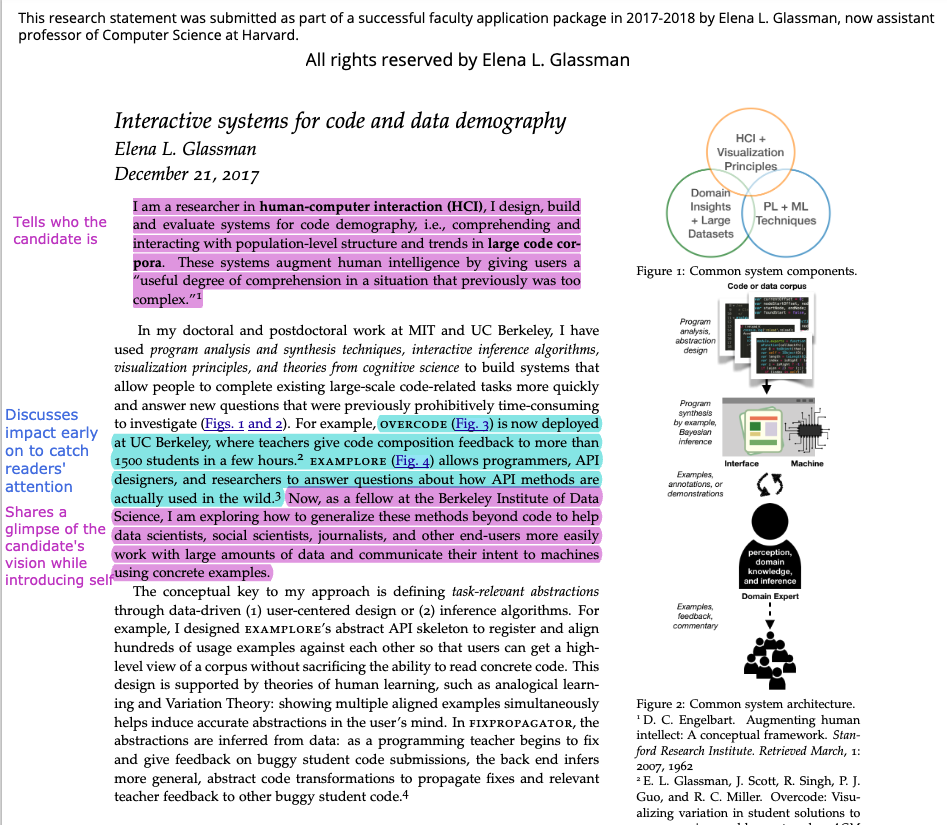
Figure: Sample excerpt highlighting organization and visual emphasis (Example 2).
Teaching Statement
+
What is it and
why is it significant?
This document outlines your teaching philosophy, specific classroom methods, and
approach to mentoring. Its significance is demonstrating commitment to student success
and showing the committee how your expertise can enrich both existing curriculum (through
teaching interest) and future offerings (through course development).
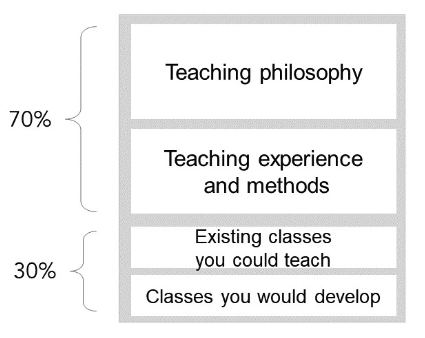
Rule of Thumb: Structure it ~70% on
Philosophy/Experience and ~30% on Future Courses. Include specific, concrete examples of
teaching success.
Core Content Areas:
Teaching Philosophy, Experiences, and Practices (e.g., project-based learning, active
learning).
Advising and Mentoring Experiences and Approach.
Courses you are interested in teaching from the existing curriculum.
Courses you would develop (shows you are thinking about departmental growth).
Discussion of managing broader audience in the classroom context.
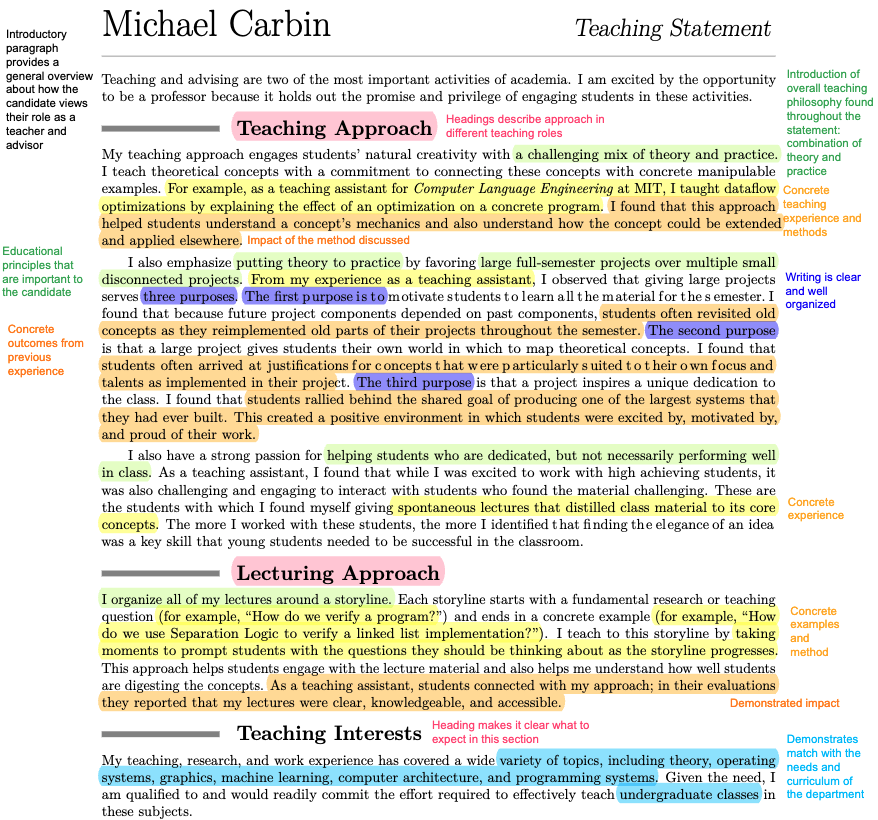
Figure: Example structure of a Teaching Statement format.
Figure: Sample excerpt illustrating teaching philosophy and classroom narrative.
Diversity Statement
+
What is it and
why is it significant?
This statement reflects your understanding of and commitment to Diversity, Equity, and
Inclusion (DEI). Its significance is demonstrating that you are prepared to contribute
to a supportive and equitable learning and research environment, aligning with modern
institutional values.
Rule of Thumb: Focus on actionable steps and
personal impact/reflection, not just theoretical commitment. Structure it ~70%
Past/Knowledge and ~30% Future Efforts.
Core Content Areas:
Knowledge and personal Commitment to Diversity.
Demonstrated Experience with DEI (a track record of advancing DEI efforts).
How you ensure Equity in Teaching and Research.
Specific Inclusive Practices (in the classroom, lab, or service).
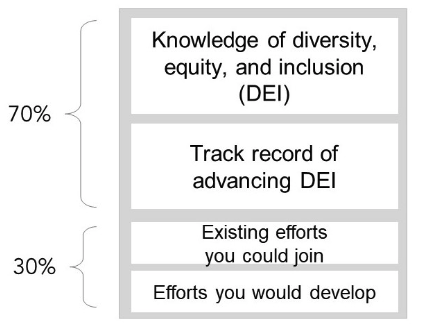
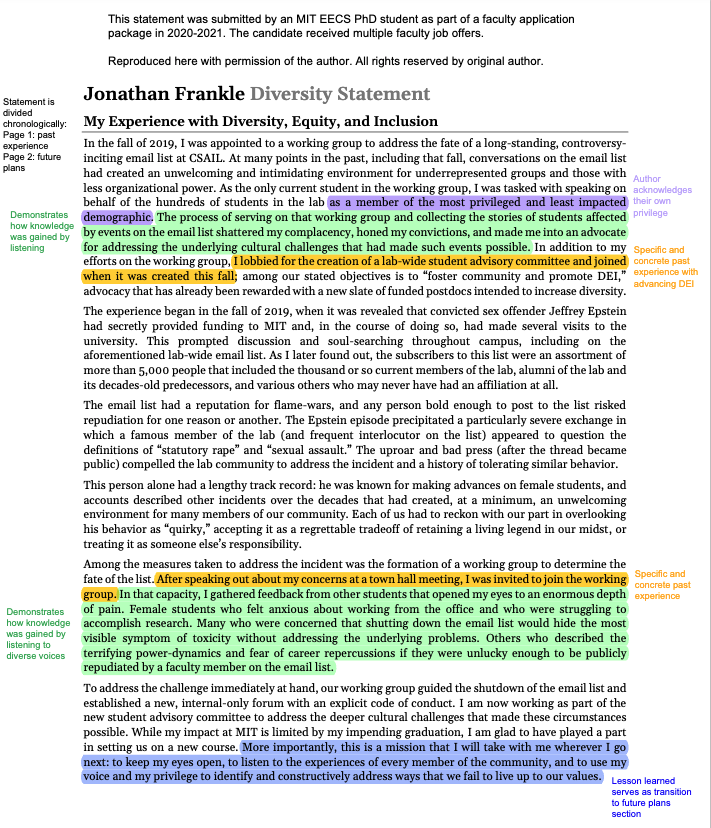
Figure: Example structure of a Diversity Statement format.
Figure: Example demonstration of diversity-focused experiences and initiatives.
Letters of Recommendation (LOR)
+
What they are and why they matter
Fresh from my own cycle, I learned that LORs carry a different kind of weight than any statement you write yourself.
They’re confidential endorsements that help a committee answer three questions quickly: Can you lead an
independent research program? Will you contribute meaningfully to teaching and mentoring? Would we want you as a
colleague?
Rule of Thumb: Choose writers who can speak closely and
specifically about your best work and growth.
Who to ask (and why)
I treated my letter writers as a balanced panel:
Advisor: Non-negotiable. Advisor is your champion. Advisor would anchor your research credibility and trajectory.
Mentors & collaborators: People who’ve seen you lead, publish, or mentor—ideally across more than one project.
Industry professional (if relevant): If you have closely worked with them.
When to request
Earlier than you think. I started outreach as soon as my target list was sketched—well before deadlines—so writers
could pace the workload and I could supply polished materials. Early requests reduce stress for everyone.
How I asked (what worked)
Get consent first: A brief email or quick chat: “Would you be comfortable writing a strong letter for my faculty applications?”
Set expectations: Share an estimated number of applications and the typical window (e.g., Oct–Dec). It can be a lot—acknowledge that.
Provide a toolkit: CV, draft statements (research/teaching/diversity), representative papers, and a 5–7 bullet “highlights” list.
Make timelines clear: A simple table of schools and due dates prevents last-minute scrambles.
Respect their time:Recommenders are busy; A gentle reminder can be useful.
Strengthening your case
Invite specifics: Politely note areas where concrete examples help—e.g., “leading X project,”
“mentoring Y students,” “devising Z method,” or “service/outreach contributions.”
Align to the target: If a school values undergraduate mentorship or center-level collaboration, say so in your brief to writers.
Follow up thoughtfully: Send a sincere thank-you and occasional updates (interviews, offers).
People invest more when they see their support making a difference.
My quick checklist: Advisor ✔︎ · Two additional writers who know my work well ✔︎ · Early consent ✔︎ ·
Materials packet ✔︎ · Deadline tracker ✔︎ · Gentle reminders ✔︎ · Thank-you + updates ✔︎
Other/Optional Application Elements
+
Leadership Statement: Very rare, but may be requested for specific leadership-track.
Transcripts: Required for some schools.
3. The Interview Process
Congratulations! on getting an interview invitation. You’ve moved from the broad pool to a
shortlist the committee genuinely wants to learn more about. Think of interviews as a sequence: a concise
Zoom/phone screen to confirm fit and clarity, followed by an on-campus visit where your job talk,
meetings, and informal interactions round out the picture. Your aim is to present a calm, coherent story:
a clear research agenda, a thoughtful teaching approach, and the kind of collegial energy people want in a
long-term colleague.
Zoom/Phone Screenings (Shortlist)
+
What they’re looking for:
About / Elevator Pitch (2–3 mins): Who you are, your research theme, one signature contribution, and where you’re headed.
Department & School: Why this unit and institution? What institutional issues interest you? How will you contribute to research, teaching, mentoring, and service?
Research: One project in detail; broader significance; where it fits; collaboration ideas; funding plan (mention specific NSF programs if relevant); early startup needs.
Teaching & Diversity: Courses you can teach immediately (existing catalog) and 1–2 you would develop; how you support diverse learners in classroom and lab.
Your questions (keep them simple): Teaching load (pre/post-tenure), mentorship for juniors, grant support, class sizes, course assignment input, lab space, student recruiting.
Preparation & delivery:
Prep: Test camera/lights/mic; rehearse concise answers; keep a one-pager for each school; know committee names and 2–3 department highlights.
During: Comfortable but formal attire; notes on a side screen; answer clearly; avoid rambling; be courteous and conversational.
Mindset: You’re evaluating them too—fit is mutual.
Job Talk (Top 3–4 Candidates)
+
What worked for me:
Choose the right content: Showcase your most exciting, impressive work—what defines your research identity.
Structure highlights content: Use a clear, hourglass-style flow that brings people from the big picture into your core results and back out to impact/future.
Practice relentlessly: Many times, at different stages, with different audiences; rehearse Q&A separately.
Slides: Less text, more visualizations; include a “key contributions” summary slide.
Time split (~45 mins): ~34 min current work + ~6 min future work + ~2 min collaboration + ~2 min grant plan + ~1 min teaching.
Fundamental pieces to include:
Research overview & motivation (why the problem matters to the field/society)
Methodology & key findings (what you uniquely add; clarity over jargon)
Probe resources: RAs/TAs, computing services, research space, admin support.
Search Committee:
Where they are in the process; how many campus invites; decision timeline; when you’ll hear back.
Context of the opening and expectations around workload (courses, advisees, service).
Dean / Associate Dean / Director:
Discuss institutional support, career growth, strategic priorities, and the department’s role in the college.
Ask about five-year plans, strongest/up-and-coming units, and (at public institutions) state funding climate.
Student Panel:
Focus on teaching philosophy, student engagement, mentorship style, research opportunities, and recruiting.
Common mistakes: Showing up without tailored questions; mismatching tone (overly formal or too casual); rushing or finishing too early.
Informal Interactions (Meals, Hallways, Tours)
+
These moments often shape final impressions. Be personable and professional—curious, relaxed, and sincere.
Meals & casual chats: Balance professionalism with warmth; it’s fine to share hobbies or family if you’re comfortable.
Questions they may ask: Why this institution? How do you see yourself fitting the community? What do you enjoy outside work?
Use the opportunity: Read the culture, show interest in others’ work, and picture your everyday life there.
Self-care: Keep yourself calm and relaxed (I know—sometimes very hard). Small resets between meetings help.
4. Negotiation and Offer Evaluation
Congratulations on reaching the offer stage! At this point, the department wants you.
Negotiation is not about proving your worth—it’s about ensuring that your first few years set you up for
long-term success. Approach this phase calmly and confidently. Remember: every part of the offer
(salary, startup funds, space, teaching load) contributes to your ability to launch a thriving research
and teaching program.
Understanding and Evaluating the Offer
+
The first step after receiving an offer is to understand its components clearly and
evaluate how well it aligns with your goals. Your decision shouldn’t hinge solely on salary—
it’s about the ecosystem you’ll build in your first few years.
Key Components: Base salary, summer salary opportunities, startup funds, student support, teaching load, and service expectations.
Institutional Resources: Access to lab space, computing resources, research assistants, and travel funds.
Support Structure: Ask about mentorship programs, grant-writing support, and teaching release for new faculty.
Salary Benchmarks: Use reliable sources such as the CRA Taulbee Survey to gauge salary ranges by rank and institution type, adjusting for cost of living.
When comparing offers, consider institutional type (R1-public, R1-private, R2-public, R2-private) and
long-term fit—both for research and for life outside work. Ask yourself: “Where will I grow best?”
Negotiation Strategies, Startup Packages, and Common Pitfalls
+
Negotiation is a normal and expected part of the process. The tone should always remain
collaborative—departments want you to succeed. Be transparent about your needs and
prioritize requests that directly enable your research, teaching, and mentoring plans.
Prioritize Your Needs: Identify your must-haves versus nice-to-haves before negotiation (e.g., lab space, postdoc or student funding, computing equipment).
Be Prepared to Discuss: Startup funds, summer salary coverage, lab space requirements, relocation assistance, and dual-career (spousal) accommodations.
Startup Package Breakdown:
Equipment and computing infrastructure
Graduate student and postdoc support
Summer Salary Support
Travel funds for conferences and collaborations
Publication and open-access costs
Relocation
Finally, remember that negotiation sets the tone for your first few years. It’s a professional dialogue, not a confrontation.
Common Pitfalls:
Focusing too narrowly on salary while overlooking startup or long-term growth potential.
Accepting the first offer without countering or discussing key needs.
Failing to ask for commitments in writing (especially for shared lab space, equipment, or personnel).
5. After-Offer Visits
🎉 Big Congratulations! You’ve made it through the most demanding stages of the faculty job search — applications, interviews, job talks, and negotiations — and now you have an offer in hand.
The after-offer visit is both a celebration and a final checkpoint.
It’s a chance to see your potential new workplace in person, meet colleagues you’ll soon collaborate with, and ensure that the environment feels like a true home — for both your professional and personal life.
Take time to experience the city or town with your loved ones. Visit neighborhoods, schools, grocery stores, and local restaurants.
In my own visit, for example, I remember searching for a good place to get Biriyani — because these small things really matter when you imagine your life beyond campus.
Think of this trip not just as an institutional tour, but as a preview of your future lifestyle.
Purpose of After-Offer Visits
+
The main goal of this visit is to confirm that both you and the institution are fully aligned before finalizing the contract.
It’s your opportunity to translate written promises into tangible observations.
Finalize negotiations and view facilities: Confirm lab spaces, shared infrastructure, and office setup; ensure startup commitments match what’s available.
Meet potential colleagues and collaborators: Build early relationships and discuss how your work may connect with existing research clusters or centers.
Explore housing and local life: Some institutions may arrange real-estate visits or connect you with relocation specialists or realtors.
Use this to assess neighborhoods, commute times, and amenities that fit your lifestyle and family needs.
Key Considerations
+
Treat this trip as a holistic evaluation — one that blends professional, logistical, and personal considerations.
If possible, bring your family or partner along so everyone can experience the environment firsthand.
Clarify expectations: Confirm onboarding timelines, first-year teaching load, lab setup schedule, and any relocation reimbursements.
Assess the community and accessibility: Explore healthcare facilities, schools, and international grocery stores; see how connected the city is to major airports or hubs.
Look for cultural comfort: Check for restaurants, places of worship, or cultural groups that align with your background and lifestyle — yes, finding your favorite Biriyani spot absolutely counts!
Final Decision-Making
+
After your visit, take time to reflect. The decision to join a university is both intellectual and deeply personal.
You’re choosing not just a job, but a community that will shape your next decade.
Weigh all factors: Balance research support, mentorship opportunities, department culture, and the feel of the city itself.
Discuss with mentors and peers: Seek input from advisors and colleagues who have recently transitioned into faculty roles — their perspective helps clarify trade-offs you might overlook.
Trust your instincts: Once you feel a genuine sense of fit, commit with confidence. You’ve earned this.
Personal note: During my own visit, I realized that the small details — friendly hallway conversations, the surrounding community,
even the availability of good food — mattered as much as research alignment. Those are the moments that help you see where you truly belong.
6. Pitfalls and How to Avoid Them
The faculty job search is a marathon of preparation, patience, and perspective. Even the strongest candidates encounter challenges or setbacks along the way.
Most pitfalls are avoidable with awareness, self-reflection, and feedback. This section distills some of the most common missteps I saw (and sometimes made myself) during my own journey — and how to sidestep them.
Common Pitfalls and How to Avoid Them
+
Overlooking Fit:
Ensure your goals align with the department’s mission and future direction.
Read the department’s strategic plan, faculty profiles, and recent initiatives.
Undervaluing Negotiation:
Don’t shy away from negotiation—departments expect it.
Be strategic and holistic: startup, mentoring, and service load matter as much as salary.
Handling Rejection:
Rejection is normal and often reflects institutional priorities, not your worth.
Seek feedback where possible and use it to refine your materials and approach.
Personal reflection: I received early rejections from places that seemed perfect on paper — and later realized those weren’t the environments where I’d have thrived.
Sometimes a “no” is simply a redirection toward a better fit.
Where Things Can Go Wrong
+
Inadequate Preparation:
Rushed materials or inconsistent narratives can sink a strong profile.
Start early and seek multiple rounds of feedback on your research, teaching, and diversity statements.
Misalignment with Institution:
Understand the mission, size, and expectations of your target institutions (R1, R2, or PUI).
Don’t recycle a generic package—customization shows genuine engagement.
Overconfidence or Underselling:
Balance confidence with humility—show enthusiasm, but let evidence speak.
On the other hand, don’t downplay your achievements or assume “they’ll see it in my CV.” State your impact clearly.
Recognizing Red Flags in Institutions
+
Lack of Transparency:
Be cautious if job descriptions or responsibilities remain vague even after interviews.
Hesitant or evasive answers about funding, resources, or tenure processes may signal internal challenges.
High Turnover Rates:
Repeated faculty departures or short tenures of previous position holders can indicate instability.
Ask neutrally about faculty retention and departmental climate during your visit.
Misalignment with Values:
If diversity, mentoring, or collaboration are important to you, look for evidence that the department truly supports those priorities.
Trust your intuition—if conversations feel performative or dismissive, take note.
Final advice: The right offer isn’t just about prestige or numbers—it’s about alignment, respect, and growth.
Choose the environment that sees your potential and values your contribution.